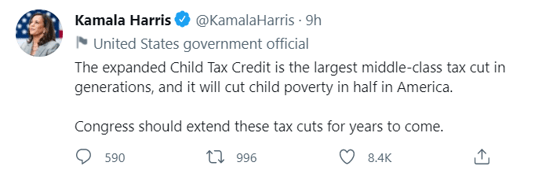
Early on in the Biden administration, Vice President Kamala Harris tweeted the message below. In her tweet, she claimed that the Child Tax Credit (CTC) would cut child poverty in America in half. The question is now if this assessment is correct or if this policy assessment is based on a skewed image presented in the measurements for poverty reduction. Arguably, the latest CTC appears to have some merit, as a few studies have suggested. In this article, some of these points will be addressed and a conclusion on the effectiveness and possible impacts of the policy will be considered.
A brief background on the US Child Tax Credit
Generally, the American taxpayer can utilize a number of tax credits, including the CTC. The first common credit was provided by the Taxpayer Relief Act in 1997. By the end of 1998, the original tax credit was $500 per child under the age of 17. Following the Taxpayer Relief Act in 2012, the amount doubled for the first time. By 2017, Congress had agreed to changes to the CTC under the Tax Cuts and Jobs Act (TCJA), which once again doubled the amount per child from $1,000 to $2,000 and made approximately $1,400 refundable. Ultimately, the TCJA set a limit of 15% earnings above $2,500, meaning low-income filers would not have access to the much needed credit. Furthermore, the Tax Policy Center stated that the TCJA is also set to expire in 2025 and thus the CTC will revert to tax credit estimates prior to 2017. This is indeed a notable aspect to keep in mind when following possible impacts of the American Rescue Plan (ARP)!
CTC under the American Rescue Plan: Cutting poverty in half?
Having a base understanding on the origins of the CTC, the ARP comes at a critical time following the COVID-19 pandemic in order to enhance the previous endeavors. As the American Rescue Plan’s CTC outlines, tax filers could claim $3,600 per child under the age of 6 and up to $3,000 per child ages 6 to 17. However, compared to previous CTC measures, the ARP added a unique angle to this tax issue. Rather than receiving one lump sum when taxpayers file their returns, the IRS was directed to disburse monthly advanced payments as of July 2021. With the current disbursements, the CTC is set at $300 per month for each child under 6 and $250 for each child between 6 to 17 for the next six months. As a result of the legislation and the actions taken, the total annual poverty rate is estimated to decrease from 13.7% to 8.7% (directly impacting the child poverty rate as well). This estimate was found in combination with extended pandemic related unemployment benefits, the Supplemental Nutrition Assistance Program benefits (SNAP), the $1,400 recovery rebate, and lastly the advanced pay of the CTC.
According to the same study by the Urban Institute, these measures have the potential to reduce the projected number of people in poverty in the US from 44 million to 28 million. Moreover, apart from the decrease in annual poverty, this estimate indicates the projected poverty rate for children would be cut by half. As pointed out in a previous Policy Crossroads’ article, the measurement of poverty heavily depends upon a number of questions. As is the case in many studies, we must not only consider who compiled the data but which metrics are being used in the analysis. To illustrate, the 2019 US census has shown an official poverty rate of 10.5%, with 34 million people in poverty compared to the different estimates from the Urban Institute in the same year.
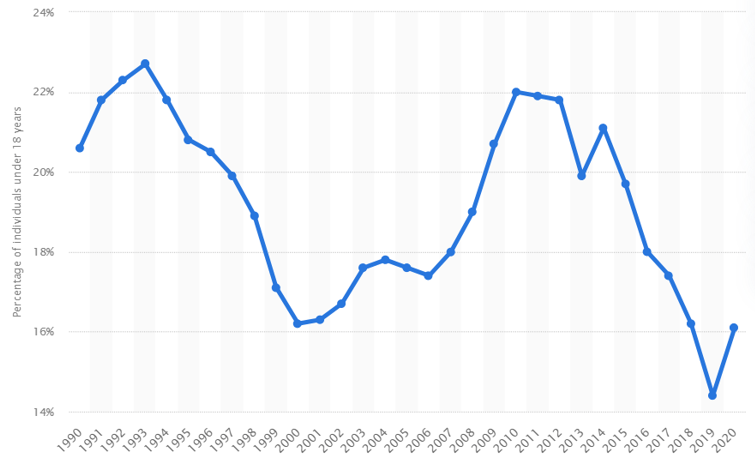
Bearing these details in mind, it is perhaps most useful to take a step back and look at the historical trends on children in poverty. The graph below shows the child poverty rate in the US from 1990 to 2020 based on data from the Current Population Survey (CPS). As the graph indicates, the child poverty rate was the lowest in 2019.
Effectively, the graph also shows a steady decrease in the child poverty rate from 2014. What is interesting there is the rise in rate of child poverty throughout the 2000s and the fall again from 2014 onwards. It thus begs the question how effective the previous CTC measures were.
Now to return to the fundamental question raised here, will the ARP CTC cut child poverty in half? A typical answer in the academic community might sound something like, “it depends”. However, the central point it depends on here is relatively straightforward. It primarily depends on whether Congress will approve the CTC measures to keep up this current commitment. In a recent letter to Congress, more than 400 economists urged them to continue the CTC on a permanent basis. In their arguments, the economists detailed how the CTC can drastically improve the lives of millions of children and promote long-term economic prosperity by reducing child poverty. Moreover, the Russell Sage Foundation published a research article in 2018 calling for a universal child allowance, which would steadily reduce the child poverty rate. As evidence that such a policy would indeed have such an intended impact, one recent study found the monthly installments have already shown a significant decrease in child poverty.
Towards universal child benefits
Apart from some of the diverging estimates on poverty in the US, there is ample evidence that the trends, whether increasing or decreasing, are usually similar. So, will the new CTC measures cut poverty in half? Considering the available evidence, it is highly possible this might be the case. Besides other factors, such as the economic impacts and recovery following the COVID-19 pandemic, and state legislation on wages, the tax credit plays some role in child poverty. Throughout the previous fluctuations in the child poverty rate, a CTC was offered, even as the effects of the 2008 financial crisis took hold. Where the difference effectively begins to matter ultimately rests upon future commitments which turn the tax credit into a stable universal child benefit. On that note, there is reason for optimism that this policy will continue throughout the Biden administration. If not, it will be difficult to unravel whether six months of a child allowance will create long-term impacts on the child poverty rate.
In the past decades, there has been a pendulum swing back and forth following the expansion of welfare states and the extent of universal social provisioning towards targeted approaches used to identify and distribute social assistance more directly to the poor. During the 1970s and 1980s a shift towards more targeting approaches was advanced from proponents claiming benefits should be diverted to those needing them the most. Naturally, this shift in social policies seemed to accompany a less subtle shift towards a neoliberal agenda that took place throughout the 1980s. In this way, policy pillars were more centered around lowering of corporate and income taxes associated with pay cuts to public spending and downsizing social programs. However, over the past two decades discussions have once again reignited regarding universalistic approaches to social provisions, and less explicitly their function in reducing poverty (Desai, 2017).
In the academic and developmental spheres, there is an abundance of literature discussing universalistic and targeted approaches on social protections and policy. Generally, the two approaches are juxtaposed to one another with numerous scholars advocating universal approaches and on the contrary, others advancing targeting schemes aimed at the poor. Between the approaches, there appears to be a larger spectrum, particularly in terms of universality. To elaborate, there are different conceptualizations of universal social provisioning, such as truly universal and conditionally universal policies. Under truly universal policies, states or institutions might provide a universal basic income, whereas conditional policies might entail social security and financial contributions to the existing system (Powell et al., 2019). Additionally, within this social policy spectrum there is the notion of “targeted universalism”, which scholars and researchers have adopted in various forms (c.f. Jacques & Noël, 2021;Skocpol, 1991). Moreover, international organizations, such as the World Bankand the International Labour Organization will often refer to both concepts either separately or in a similar manner of targeted universalism.
At the center of many discussions on social policies are pertinent questions regarding the persistence of social inequality, social segregation, and stratification. Understanding the focus on these questions helps to shed light on why advocates of the universalistic approach tend to recognize these issues and may therefore be less likely to explicitly focus on poverty reduction strategies as such. Instead, grappling with poverty becomes a deeper discussion about the ideological position on how it is conceptualized. Furthermore, it largely demonstrates more structural issues around social policy and the necessary structural transformations around the development process as a whole. In this sense, it is more a discussion of political economics than anything else. This points to the need to re-frame the conversation around poverty and focus more intently on providing or enhancing the universal basis for social protections and safety nets in societies. In reality, universal coverage as a social protection right is meant for everyone and in this regard would include the needs of those defined as poor and vulnerable.
The arguments for adopting a universalistic approach compared to targeting objectives are convincing for at least two reasons. First, some of targeting arguments address the seemingly “self-evident” idea that poverty targeting is cheaper and that the practice provides more benefits for the poor, which is a fundamental misrepresentation of targeting. Indeed, while providing a small percentage of the population benefits is cheaper, the external effects of low quality social services and limited state spending might be greater (Kidd, 2016). Second, poverty targeting is also prone to inaccuracy, especially within developing countries with weaker administrative and statistical capacities to collect such data. These issues then lead to higher levels of social conflict and stratification within communities. Due to these issues prone to targeting schemes, universal policy designs are more effective in the sense that broader schemes are provided to all.Though universal schemes may not necessarily be feasible in all domains of social policies in all countries, a basic floor of social protections (i.e. in health and education) would at least more broadly cover those living in poverty.
Many of these points related to the discussion between targeting and universalistic approaches call attention to the most widely utilized approaches of poverty measurement. In essence, they all play a role in the discussion, even if the narrative around poverty is commonly directed away from a focus on structural transformation in political economics. The subsequent sections of the paper will outline these issues, while referring back to the literature on various conceptualizations of poverty. From this perspective, other conceptualizations are deemed part and parcel of the poverty reduction strategies across time. In the first place, an evaluation of targeting approaches will be considered that broadly encompasses substantial issues with targeting. Then moving beyond the core universalistic approach discussion, more attention will be placed upon the role of multidimensional poverty measurements and the capabilities approach. This section helps support the argument of how these different measurements create more complex thresholds beyond the basic poverty line in an attempt to identify the poor, and therefore sidesteps uncomfortable issues of social inequality. Following those conceptualizations, a reflection on the theoretical concept and the practical application of the participatory approach is discussed. The emphasis here is on the relation to framing the narrative around poverty reduction used to give a voice to the poor, while practically missing the mark in many cases. Finally, the discussion and conclusion tie back in to the universalistic approach and the concept of structural transformation as an inexplicit means of poverty reduction.
Compared to a universalistic approach, targeted approaches are introduced in order to provide benefits or protections to an individual or group of people deemed to be in need. The examples of targeted policies are abundant in many forms and across a wide range of countries and institutions. One of these policies, for example, is to provide food stamps or other means of food access to low-income families. However, targeted policies also extend to employment or admissions, as seen in affirmative action policies (Powell et al., 2019). In the first instance, affirmative action policies generally establish targets for hiring or contracting minorities or disadvantaged individuals. Moreover, for education, similar quotas are set in order to provide access to schools, colleges, and universities. Though these policies in various settings might significantly and positively impact the equality of outcome, the effects of poverty targeting might entail more negative aspects.
In the context of poverty, targeting in itself would not necessarily be a problem if it were utilized as one dish in the policy menu. However, the social aim of policy makers to eradicate poverty by targeting those most in need is subject to political and ideological processes of whom to target. In this sense, the problem is that targeting is more likely to lead to stigmatization and segregation effects on the people generally defined as “the poor” (Fischer, 2018;Mkandawire, 2005). This is perhaps a side effect of empowerment attempts by states as well as the World Bank in the quest to provide a “voice to the poor”. Rather than empowering people to leverage their status through pro-poor coalitions, they are likely to be subjected to embarrassment within local communities for being considered lazy or dependent on the state. As Sen suggested, special benefits or programs that require identification as being poor not only impacts the self-respect for oneself but also the respect from society (Sen, 1995). Thus, the administrative process involved in applying for benefits and receiving benefits has a great potential for those receiving them to feel stigmatized within their own communities. This is often widely cited throughout various streams of academic literature as a discussion on “deservingness” or otherwise criteria for deservingness. If framed as a narrative on deservingness, it is no surprise that some social programs hold more or less negative connotations than other forms of welfare benefits, such as referring to someone living on welfare. As a consequence, segregation occurs from the selective processes of targeting or self-identification. Indeed, it seems segregation is both a political and social outcome in the sense that societies and political elites determine the deservingness criteria and undermine cross-class solidarities (Fischer, 2018, p.222). Whether or not this is necessarily a causal process or merely a side-effect, it remains pertinent in spotting outcomes of targeting policies.
Next to the potential stigmatizing and segregating effects of poverty, targeting policies have often been shown to be imprecise in their efforts. As Mkandawire (2005) identified, there are two predominant problems indicative of the imprecisions: underpayment (i.e. someone who deserves benefits and is denied or missed) and overpayments (i.e. someone who is not categorized as deserving them or is otherwise not technically qualified) (Mkandawire, 2005, p. 9). Taken from this perspective, it is easy to understand how these issues may exacerbate issues of stigmatization as well. Although an argument could be made against unequal distribution of social provisions within a universalistic policy design, it appears more likely that the disproportionate disbursements in a targeted system would create higher levels of inequality due to the imprecisions. To briefly clarify, those in predominantly targeted systems have been identified and selected as beneficiaries in a system that otherwise does not widely utilize social provisions, thereby potentially excluding others in need. As an example of such underpayments, studies on targeting programs in the Americas (i.e. Brazil, Chile, Colombia, Mexico, and the U.S.) have shown in different instances percentages of under-coverage from 26% upward to about 84% of the population (Peyre, 2005). Referring back to potentials of unequal distributions of social provisions, this is indicative of targeted approaches likelihood of exacerbating pre-existing inequalities. Apart from this aspect, developing countries often lack the administrative capacities or resources necessary in order to precisely target groups, which would mean the standard of error is potentially even higher those countries.
Finally, with the pendulum swinging back towards discussions of universalistic approaches, a third element still captured in this discussion is the framing of some minimalist universalism, rather than the support of targeting as a policy device in a universalistic policy design. To expound on this, it seems at the international level that organizations such as the World Bank or International Monetary Fund either support institutions or projects aimed at establishing universal targets to ensure basic coverage (i.e. healthcare coverage and education for all). As discussed throughout the literature, this appropriation of universality undermines the actual capacity of universal services in favor of limited social provisions without paying attention to their quality (Fischer, 2018, p.221). Indeed, while the international goals are stated in universalistic terms, the end means for attaining the goals remain widely selective and targeted. For example, projects for building schools whereby a given state may not be able to provide quality schooling, ensuring equal access to school, or even misrepresenting educational targets as a means for funding.
In sum, these issues of stigmatization, segregation, likelihood of imprecision, and subtle shift in re-framing the universal discussion, point to broader shortcomings that the targeted approaches from the previous decades have continuously failed to rectify. In order to actually remedy these issues, universalist advocates push for a broader umbrella of social provisions that are genuinely more inclusive or at least signal a shift towards stronger universalistic principles.
Multidimensional measurements of poverty
Whereas the unidimensional money-metric approach to poverty establishes a minimum income or baseline for poverty, multidimensional poverty measures are meant to push the progressive understanding of poverty forward. This includes studies on the multidimensionality of poverty and more abstractly, functionings and capabilities (Alkire & Santos, 2014;Sen, 1994). The focus of multidimensional poverty measures is to take the mantle of uncovering other elements associated with poverty, such as health and education. Although a lengthier review in history reveals earlier efforts at combining non-monetary and monetary metrics to measure poverty, one of the most widely utilized has become the Multidimensional Poverty Index (MPI).
Despite how progressive these measurements were meant to be in determining poverty, there are at least two central problems associated with them, in particular in their relation to universalistic approaches. The first problem is the scaling and weighting of components and whether or not this provides relevant information to how poverty is actually conceptualized. At a disaggregated level, health and education data are highly relevant for researchers and policy-makers, however, the composite indices developed to measure poverty become quite problematic. To illustrate, the combination of dimensions falls risk to either masking problems in one dimension (i.e. counterweight of education or skewed mortality rate means “being raised out of poverty”) or otherwise compounding the problem. This reflects on a more fundamental issue of choosing or omitting variables within a dimension or even prioritizing a specific dimension over another.
Another problem with the multidimensional poverty measurements is that they are liable to becoming the subject of targeting, if not already explicitly intended to be utilized for the practice. Whereas the Human Development Index (HDI) widely relied on population measures, meaning that only regional targeting is possible, the MPI expanded in dimensionality to make it appropriate for individual-level identification (Fischer, 2018, p. 119). This leads back to a central downside to targeting whereby thresholds are expanded into additional dimensions to establish a range of deservingness criteria. At the same time, these targeting schemes are prone to larger errors in the sense that outdated surveys or census might have been used to collect data for the multidimensional measurements and no longer capture recent social changes. This raises a question on what relevant information was produced and how resourceful it is in measuring poverty. Ultimately, it appears the multidimensional measurement of poverty establishes a collection of targets for minimalist milestones and again fails to capture the full picture of social needs to provide universal social assistance.
An interesting point of reference within the multidimensional measurements framework is the reliance on Amartya Sen’s work and the capability approach. This is interesting in the sense that Sen himself was more of an advocate of a universalistic approach compared to targeting schemes. Perhaps one reason Sen’s work on functionings and capabilities is heavily cited in the multidimensionality literature, is because it is viewed as a credible and theoretical stepping stone towards multidimensionality itself. Since the original conceptualization, other modifications to the capability approach have been proposed (c.f. Nussbaum, 2000). For the sake of establishing the relationship to a universalistic approach, this essay adheres to Sen’s original concepts. Likewise, the early development of the capability approach as being derived out of Sen’s entitlement theory is not addressed. In terms of defining the approach, a capability set is a group of options open to a person for a means of pursuing their own well-being, which occurs in a larger functioning space among a set of functioning combinations (so-called “n-tuples”) (Sen, 1994, p. 339). Moreover, the capability approach proposes a set of life-paths a person has the potential to follow, whereas the functionings are the subject of capabilities and ways people actually live. As such, Sen describes a deeper layer to poverty identified as the lack of freedom, or specifically capability failures needed to achieve basic functionings (Sen, 1994).
Indeed, the capability approach centers most of the attention around individual well-being, which draws notice back to the universalistic provisions of social assistance. From an individual (and philosophical) standpoint, Sen’s approach seems to present its merits for each individual achieving some level of functioning which the person values. Yet, this perspective lends itself to questions as to whether this would be necessary to identify a relationship to poverty or if it is genuinely feasible to identify in a meaningful way, and how capabilities would be addressed in a universalistic setting. As Sen himself pointed out, capability depends on the reconstruction of the counterfactual possibilities of functionings one person might have achieved (Sen, 1994, p. 334). If this reconstruction is already questioned at the individual level, then it would rightfully be questioned as a national or international tool to capture capabilities and functionings. Moreover, the adaptations of Sen’s initial work have pulled the capability approach into different directions. As an example of this, some studies seem to equate the capability deprivation closer to an understanding of basic needs and therefore obscures the lines of capabilities. Furthermore, through the advocates of multidimensional measurements, it seems capabilities and functionings are misrepresented as a tool for targeting, rather than focusing on structural and institutional deficiencies that undermine functionings in the first place.
The participatory approach
Although the “social exclusion approach” is not handled here in any great depth, it must be noted that social exclusion may come as one consequence of poverty. At the same time, social exclusion could even be brought into the fold for consideration as an aspect of the multidimensional approach or viewed as a relative deprivation of capability, as Sen might have claimed (Fischer, 2018, p.157). However, social exclusion may also and undoubtedly occur outside of poverty, emphasizing the point that it is not theoretically clear why it would be treated as a specific conceptualization of poverty per se. There is in comparison reason to argue how the participatory approach, even by means of the name, is meant to be a theoretical approach to both poverty and social exclusion. In this way, the participatory approach theoretically lends itself closer to a discussion on universality in at least two ways. First, within the historical context of development, and second, in terms of equality. In the first instance, the drive behind the participatory approach began as a counter reaction against professionalized development strategies and top-down development aid of earlier decades, usually disconnected with those deemed disadvantaged and poor. As a response, participation was meant to provide a voice to the poor and involve them in projects as development aid beneficiaries (Mansuri & Rao, 2013, p. 15). Ideally, this method of participation would touch base within communities to provide support and also help external actors understand the evolution of social needs within their states. Second, the approach idealizes a notion of participation by highlighting the focus on equality. Participation, theoretically, is therefore voluntary and would allow for all voices within a community to present themselves and contribute equally to the procedural decision-making processes.
In reality, the theoretical conceptualization of participation does not amount to an accurate reflection of the participatory approach in practice. In terms of the practical application, the downsides of the participatory approach appear much less universalistic. To illustrate, in one large-scale review of participatory efforts, it was found that the activities generally focused more on wealthier citizens, those with a higher social status or more political connections than nonparticipants (Mansuri & Rao, 2013, p. 5). As such, the poor and disadvantaged appeared to benefit less from such processes, both in terms of the distribution of resources stemming from consultations and in any meaningful decision-making processes. In terms of the numerous participatory project’s outcomes, the evidence available is mixed. As Mansuri and Rao (2013) demonstrated, studies pointing to long-term results show that income gains were limited and did not always reach the poor or disadvantaged (Mansuri & Rao, 2013, p. 214). Beyond these findings, academics and researchers have pointed out further unforeseen consequences of the participatory approach. Cornwall (2003), for example, showed that the group formation and projects aiming to promote community cohesion may reinforce divides, especially when considering minorities or genders within a given community. To illustrate this example, women in some cases would be torn between attending the community meetings and facing backlash from their partners or being chastised for publicly speaking about taboos in their culture (Cornwall, 2003, p. 1334). In another manner, Cooke and Kothari (2001) present a case against participatory projects as being an unjust exercise of power and less participative as implied. Their case is not necessarily against the methodologies employed but rather against the political discourse surrounding this approach. In this way, they criticize participation on three levels of tyranny, illustrating how participatory facilitators might reinforce external powers rather than supporting the local community, or override decision-making processes (Cooke & Kathari, 2001, p.7).
When further considering the practical potential for universality for participation, the image presented is not as promising as theoretically proposed. Indeed, Mansuri and Rao’s (2013) review directly indicates at the onset that “local participation has been proposed as a way to improve poverty targeting and build social capital” (Mansuri & Rao, 2013, p. 15). Within the context of a World Bank report from two economists, this comes as no great surprise but it does come back to the intentions and implications of the World Banks’s view or goal of targeting within universalism. In this sense, there appears to be some institutional back and forth or at least widening of the debate around targeting and universalistic approaches. From a structural or institutional setting it makes sense that the World Bank and the International Labour Organization would promote both, or at least advocate some version of targeted universalism. In essence, this type of language might likely be invoked in order to appease donors and other facilitators of the institutions. On one hand, it addresses neoliberal principles of low taxation and allocating resources only to a determined group within societies. Furthermore, this is masked by the idea that targeting provides higher benefits for the poor. On the other hand, the universalistic aspect politically connects with those who recognize the fundamental value in supplying social protections and safety nets to address the more structural problems behind poverty.
Discussion and conclusion
The conceptualizations of poverty presented here offer alternative perspectives on how the subject might be approached. More than this, some of the conceptualizations move beyond an individual poverty line to more progressive ideas that capture different aspects of being poor, such as being deprived in an educational or health dimension of poverty or experiencing a capability failure. Later in the 1990s, poverty studies began to emphasize the importance of participation so that the voices of the poor would be considered. And among all of these approaches, they have been widely utilized as the best means to target and identify the poor and disadvantaged. In the meanwhile, numerous studies have emphasized the shortcomings associated with targeting, such as the structural incapacity to target with closer precision, higher administrative costs, and the external effects of segregation or greater stratification in society (Kidd, 2016;Mkandawire, 2005). Yet, even acknowledging the shortcomings, domestic and international institutions have been propped up in a manner to continue using the measurements in this way. For this reason, the World Bank will often broadly reassert the need for participation to tackle the multidimensional aspects of poverty. Indeed, these are still meaningful objectives, especially when bound to financial constraints and limited in context.
Underlying the approaches, and to some extent the financial constraints associated with maximizing their utility, is an embedded political process. This process is highlighted by the neoliberal agenda setting that took place throughout the 1980s and the fundamental belief that this is the best means of reducing poverty. Moreover, the agenda setting has been brought into the fold in the process of development and globalization and expressed differently throughout global agendas (i.e. Sustainable Development Goals). As previously suggested, this is perhaps a result of institutions shaped by varying external interests so as to emphasize an interest in targeted universalism that satisfies both sides of the targeting and universalistic debate. As a result of this, there is still a fundamental risk associated with universalistic social provisioning, which is ultimately one alternative motivation behind the international targeted universalism scheme. Under the notion that “a rising tide lifts all boats”, the idea of providing basic coverage could also be a means to reach bare minimum levels of subsistence. As such, providing basic healthcare or education for all, as stipulated in many Social Protection Strategies, could also be a means to claim particular goals have been met without further consideration for quality of care or education. Thus, similar to any arbitrary poverty line or threshold, a universalistic approach does run a potential risk of being over taken by international institutions, undermining the true utility of social provisioning.
Bearing in mind this potential risk associated with a universalistic approach, it does not seem necessarily probable that this would be the aim. Instead, the broad external influence on international institutions appears more likely to be a motivation for targeted universalism. In this manner, the international institutions charged with the reduction of poverty might push an umbrella of social protections, while continuing efforts to target poverty. For this reason, it remains worth noting that the measurements themselves are not necessarily wrong but rather that they fundamentally shape how poverty is addressed. Although statistical capacity is still developing in some countries, the efforts of measurements serves as an individual tool in widening social policy in a national context.
As Skocpol (1991) has suggested, within the context of a universalistic design, each citizen would be ideally covered by social protections and this would inevitably decrease stratification across classes within a society. In this sense, universal policies could reduce poverty and incorporate different policy dishes or tools as individual instruments to improve the system. Furthermore, there is already evidence that developing countries have benefited from universalistic approaches in efforts to reducing poverty (Mkandawire, 2005). These findings further suggest that structural transformation and state-building were more at the center of their endeavors, with poverty reduction as one result of their developmental objectives. Indeed, this once again highlights the necessity in recognizing the political economic space that poverty studies are embedded in and how this impacts the narrative around a universalistic policy design.
Something else to be seen through the looking glass? (Estimated 5 minute read)
If you were to ask someone on the street how they would define poverty, you would likely hear the concept defined in different terms, yet more or less the same. In this hypothetical narrative, most people might say something along the following lines:
Being in poverty means you do not have enough money to meet very basic needs, such as having enough food or perhaps access to health services.
Granted this is a condensed narrative, it captures the bare essence of how people might define poverty. Beyond the short definition there would be people who could extensively elaborate on the issue and separate absolute and relative poverty. However, the point of the exercise is simply to imagine how people define the term in this concise manner.
Now try and envision a world full of academics and researchers, international organizations and non-governmental organizations, all working in the same field, yet with their own dissimilar definitions. Then of course, we cannot forget about the fieldworkerswho are physically present and involved in campaigns against poverty. Surely each group or individual is driven by the way they see the world and perceive existing poverty. Therefore, the way they approach the concept is also driven by their own understanding and experiences and how it should best be managed.
Having imagined how average people and researchers define poverty, it is time to move forward and consider how poverty is measured. Be forewarned, as this singular post will not do justice to the numerous approaches which are widely utilized by different groups!
You might already be familiar with the “dollar-a-day” proclamations in the news or advertisements. To illustrate, the World Bank has worked extensively on the money-metric endeavor for decades now, leading to the current rate of $1.90 a day based on a purchasing power parity (World Bank, 2021). If you’re below this threshold, you are considered to be in absolute poverty. The WB adjusts this rating every few years and state’s strive to examine their own relative indicator around monetary measurements. Imagine then that a state has managed to lift enough citizens above this threshold, much as was stated with the Millennium Development Goal by 2015 (Qui, 2016). Suddenly, millions of people across the globe are out of poverty because they’re above the threshold. The obvious problems with this type of measurement have been drawing more attention for years (Hickel, 2019). First, the measurements began in the 1980s and account for most of the downward trend from that point forward. This fails to account for longer periods before this time when subsistence economies, for example, were still relatively more commonplace. Second, as you may have thought to yourself, the standard is already quite low. So what if absolute poverty was measured at $3 or $5 a day? That would suddenly catapult millions back into poverty on a technicality, while still showing relatively little about their actual living conditions.
Considering this arbitrary threshold is often contested, it is perhaps no wonder others have sought to introduce different measures of poverty that extend beyond the notion of one’s purchasing power. On the other end of the measurement spectrum, others have worked on a concept of capabilities and capability deprivation (Robeyns & Fibieger Byskov, 2020). At least this is considered as an extension of being impoverished in the sense that one lacks social opportunities, a life of dignity, and political freedoms, alongside standard economic elements. Furthermore, there are scholars that have shifted the debate to a more participatory approach whereby practitioners listen to the voices of the poor within their communities (Kapoor, 2002). In comparison, this is perhaps more straightforward than the capabilities literature in the sense that “participation” is relatively clearer than what “capabilities” in terms of poverty entails. Beyond these two concepts, another one of the most popular measurements are the multidimensional approaches (OPHI, 2021). The multidimensional approaches generally include at least three dimensions of poverty: health, education, and living standards. Under the three dimensions are also relevant indicators, such as nutrition, child mortality rates, levels of schooling, and access to sanitation, water, and electricity. This is perhaps one of the most widely utilized tools since it appears to capture different layers of poverty that could be experienced, though the approach also has its fair share of critics.
It should be stated that the purpose here is not to show that there is necessarily one method which is better than the other but that the very conceptualization of poverty leads to the next step: how to measure it or at least critically consider how it is being measured (cf. Fischer, 2018). This is at least one area where the academics, researchers, and fieldworkers might find some mutual agreement. At least discussing how existing measures could continuously be improved upon is a step forward. After all, the familiar saying along the lines that you cannot manage what cannot be measured, speaks volumes. If we’re to overcome an issue, we first need to address what we define as the issue and from there take the steps to alleviate it.
In the subsequent posts on poverty, the main focus will be to look at national policy areas and how certain state’s operationalize their own campaigns against poverty.
***Please note: some of the cited material is not from the original authors, such as Amartya Sen or Robert Chambers. Instead, they’re taken from introductory materials or other authors reviewing their concepts. This is not meant to be indicative of my professional views on these approaches.

 Policy Crossroads